 [ IMAGE PLACEHOLDER ]'">
The Global Stage is Set
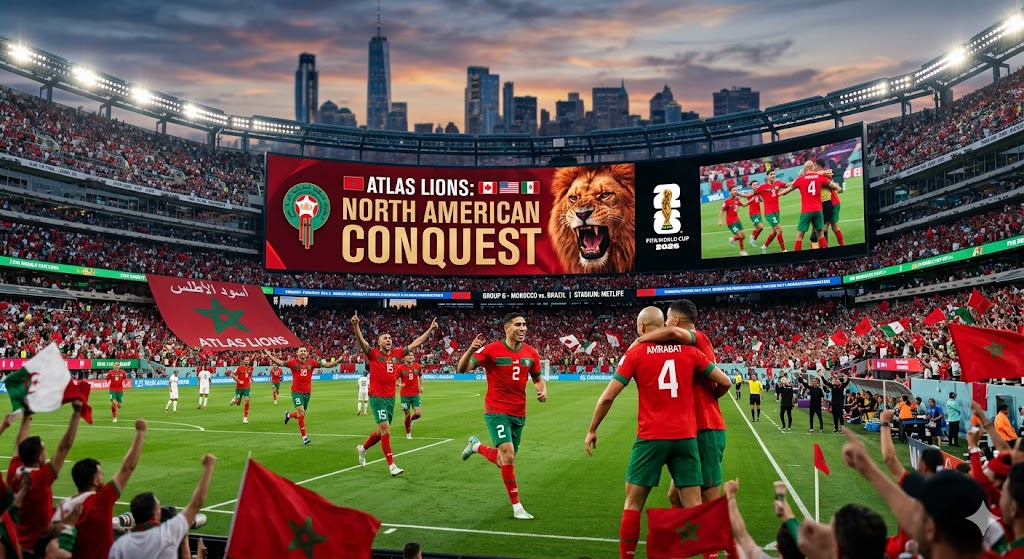
The countdown to the 2026 World Cup has officially begun. Across the iconic stadiums of the USA, Canada, and Mexico, Morocco returns not just as a participant, but as a global powerhouse. After the historic 2022 run, the world's eyes are fixed on the "Atlas Lions" to see if they can redefine football history once again. This isn't just about qualifying; it's about confirming Morocco's seat at the high table of elite football nations.
⚖Moroccan Mastery on the Whistle
Morocco’s influence extends beyond the pitch and into the officiating elite. FIFA has officially selected Jalal Jayed as a head referee, supported by assistants Mustapha Akarkad and Zakaria Brinsi.
Meanwhile, Hamza El Fariq will command the VAR room. This technical representation highlights the immense progress made by the Moroccan Federation (FRMF) in professionalizing every aspect of the game, ensuring that the Moroccan vision is present in every critical decision on the field.
The Strategy: Navigating Group G
The draw has placed Morocco in a high-stakes group featuring Brazil, Scotland, and Haiti. To top this group, Walid Regragui will need more than just spirit. Against the Samba Boys of Brazil, the focus will be on "Low Block" discipline and lightning-fast transitions.
The Scotland game will be a battle of aerial duels and second balls, requiring a physical presence in midfield. Finally, Haiti represents the "trap game" where tactical patience will be key to breaking down a deep defensive line.
Tactical Evolution: Beyond 4-1-4-1
In 2022, Morocco was the master of defense. In 2026, we expect a more proactive version of the Lions. With the emergence of technical wizards in the half-spaces, Morocco is shifting towards a more fluid 4-3-3 that can transform into a 3-4-3 during the build-up phase.
The role of Achraf Hakimi has evolved from a traditional fullback to a "wide playmaker," while the midfield engine remains the heartbeat of the team, balancing the defensive cover with creative vertical passes.
The 48-Team Revolution
The 2026 edition introduces a grueling 48-team format. This isn't just a tournament; it’s a marathon of tactical endurance. Squad depth will be the deciding factor. Morocco enters this expanded era with a blend of seasoned veterans and a new wave of hungry, technical youth from the U23 Olympic squad. Managing fatigue and rotations in the North American heat will be Regragui’s toughest challenge yet.
🇲🇦 Morocco: A Rising Empire
This isn't just about 90 minutes; it's about a nation's sporting evolution. From the world-class infrastructure of the Mohammed VI Football Complex to a distinct tactical identity, Morocco has become a blueprint for success in Africa and the Arab world.
In 2026, the mission is clear: Keep the dream alive. The Atlas Lions are no longer just "participants"—they are contenders. The roar of the lion is ready to shake the stadiums of North America.